
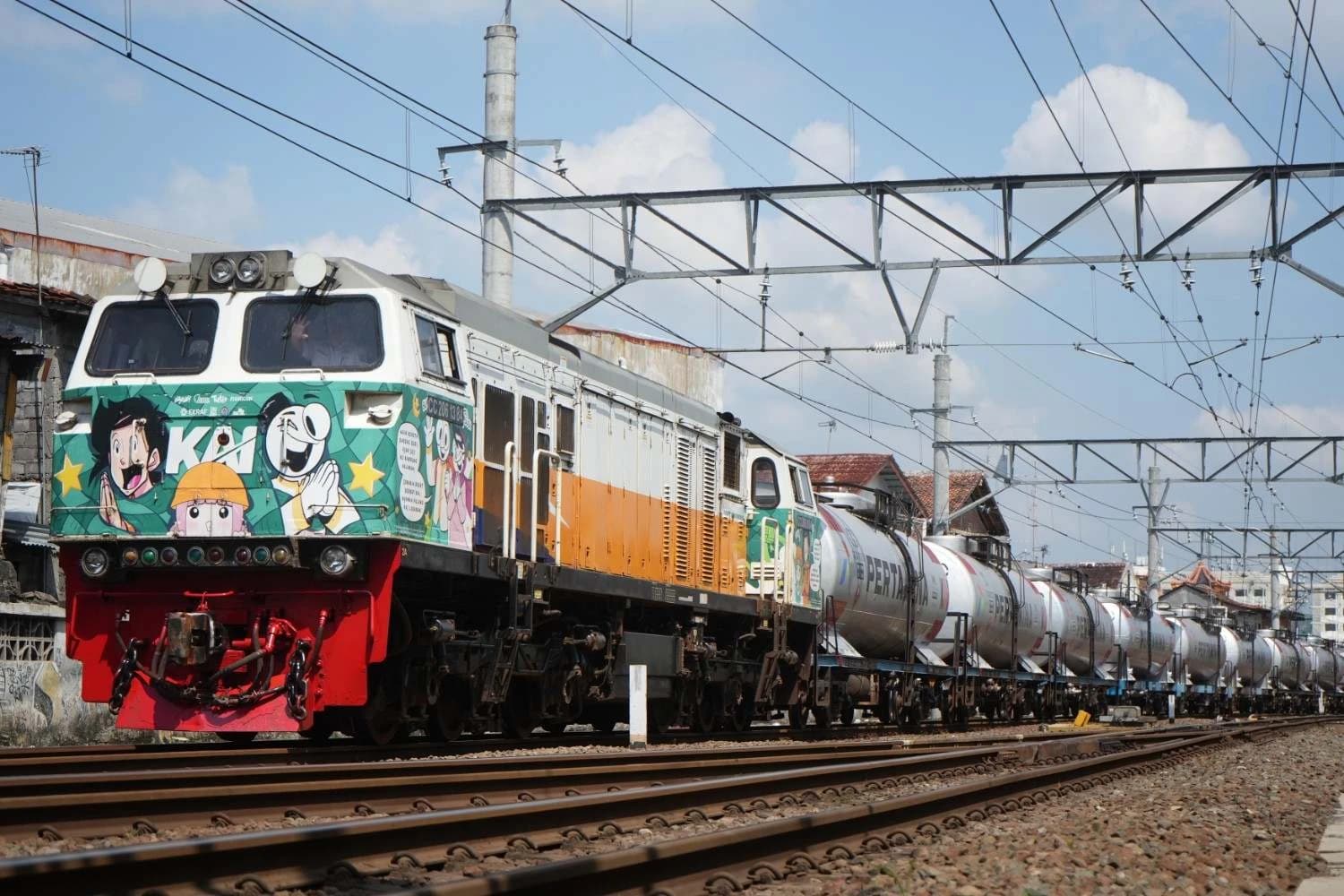
2.04 Million Tons of Fuel Transported by KAI Until September 2026, Rail Energy Distribution Grows 3.92 Percent
Energy distribution is an important part of maintaining community activities and the economy in various regions. Amidst these needs, trains continue to be used to move large volumes of fuel oil through scheduled trips in Java and Sumatra.
PT Kereta Api Indonesia (Persero) recorded 2,036,049 tons of fuel transported throughout January–September 2026. This volume increased by 3.92 percent compared to the same period in 2025, which reached approximately 1,959,161 tons. In nine months, there was an additional approximately 76,888 tons of fuel transported via the railway network.
When averaged over 273 days from January to September 2026, that volume is equivalent to about 7,458 tons of fuel per day. Fuel accounts for about 22.3 percent of the total 9,148,571 tons of KAI's non-coal freight during the same period. KAI's freight data recorded that total non-coal freight for January–September 2026 grew by 2.6 percent compared to 8,912,566 tons in the same period the previous year.
KAI Vice President Corporate Communication Anne Purba stated that fuel transportation has characteristics different from other commodities because it relates directly to the energy needs of the community, the business world, agriculture, transportation, and public services.
“Every day, thousands of tons of fuel move via train. That volume illustrates how freight train journeys become part of the energy distribution process from supply points to various consumption areas,” Anne said.
KAI's fuel transportation is carried out using tanker cars and serves the distribution of energy products in cooperation with the Pertamina Group. This network connects supply points and fuel terminals with a number of distribution regions in Java and Sumatra. The types of products transported include Pertalite, Pertamax, and Bio Solar.
The large transport capacity allows a single train set to carry high volumes of fuel in one trip. The scheduled travel pattern also enables distribution to be carried out repeatedly according to customer needs, while reducing the need for large-scale heavy freight movements via highways.
According to Anne, the development of fuel transportation is also interesting when read alongside changes in national energy policy. Starting July 1, 2026, the government began implementing the B50 Biodiesel mandatory policy. At the same time, KAI began using B50 gradually on diesel-based facilities, including locomotives and power cars.
“KAI's position in the energy issue has two sides. On one hand, trains carry fuel to meet the needs of various regions. Operationally, KAI is also adjusting the use of diesel facility fuel through the implementation of B50. Both show ongoing changes in the national energy supply chain and usage,” Anne said.
The implementation of B50 in KAI's operations is carried out after a series of technical tests, component monitoring, engine performance evaluation, and fuel quality control. Safety and facility reliability aspects remain the primary considerations in every stage of its implementation. The government established a three-month transition period starting July 2026 for stock adjustments and the implementation of B50 in the field.
Meanwhile, in terms of freight transportation, fuel realization for January–September 2026 has reached 2,036,049 tons. KAI's freight performance data as of September 30, 2026, also shows that this realization is slightly above the January–September cumulative target of 2,035,840 tons.
Anne considers that the presence of fuel transportation via train will remain relevant alongside the need for large-scale energy distribution and changes in fuel composition in Indonesia.
“Energy transition does not mean distribution needs stop. What changes are the type of energy, its composition, and how the supply chain is managed. Trains have the capacity to keep up with these changes through scheduled, safe, and customer-oriented freight services,” Anne concluded.
VP Corporate Communication KAI