
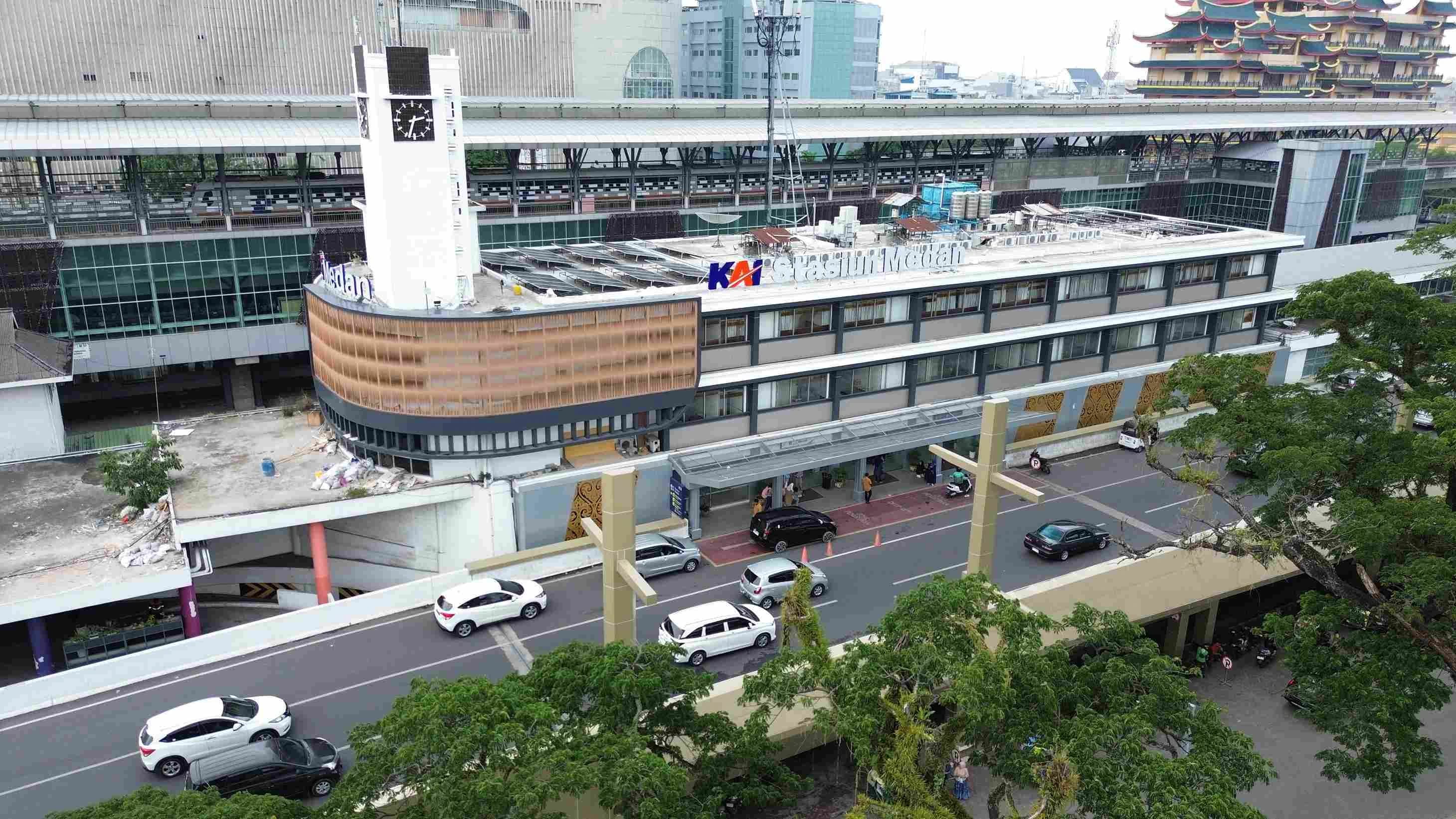
140 Years of the Medan–Labuhan Line: KAI Strengthens North Sumatra Rail's Role in Trans-Sumatra Agenda
President Prabowo Subianto's directive to make the national railway system a development focus brings significant meaning to the strengthening of KAI's services in North Sumatra. This region has a long history as one of the starting points for railway development in Sumatra, while also serving as a strategic hub in the Trans-Sumatra connectivity agenda.
The railway history of North Sumatra cannot be separated from the economic development of East Sumatra in the late 19th century. In 1883, Deli Spoorweg Maatschappij (DSM) was recorded as a Dutch private railway company that built a rail network connecting plantation centers with trade hubs and ports.
This important milestone continued on July 25, 1886, when the 16.743-kilometer Medan–Labuhan line officially began operations. This line marked the beginning of the railway's strong role in connecting Medan, plantation areas, and ports as gateways for distributing agricultural produce.
Since that time, railways in North Sumatra have evolved into an economic connector. From Deli tobacco, rubber, and palm oil to public daily commodities, trains have helped shape the flow of goods and the growth of vital cities such as Medan, Binjai, Tebing Tinggi, Pematangsiantar, Tanjungbalai, and Rantau Prapat.
KAI Vice President of Corporate Communications Anne Purba stated that the history of North Sumatra's railways shows that trains have always been present as a connector for public needs and the regional economy.
“North Sumatra's railways were born out of the need for access. In the past, they connected plantations and ports; today, they serve public travel, supply chains, industrial estates, airports, and economic centers,”
Based on 2026 data from KAI Divre I North Sumatra, the region has 476.460 km of active lines with 43 active stations spread across 13 regencies/cities. This network plays a crucial role in passenger and freight services, simultaneously connecting Medan with various strategic areas such as Binjai, Tebing Tinggi, Kisaran, Tanjungbalai, Rantau Prapat, Pematangsiantar, Belawan, Kuala Tanjung, and Kualanamu.
“Following the President's directive, KAI views North Sumatra as a vital node in the Trans-Sumatra agenda. The strengthening of railway services in this region must provide direct benefits to the public and enhance regional logistics efficiency,”
Currently, KAI Group serves the people of North Sumatra through various services, including the Putri Deli, Sribilah Utama, Siantar Ekspres, Datuk Belambangan, and Sri Lelawangsa trains. These services strengthen public access to city centers, satellite regions, workplaces, educational hubs, healthcare services, airports, and regional economic nodes.
Passenger performance indicates that trains remain a critical choice for the people of North Sumatra. In 2025, the passenger volume of Divre I North Sumatra reached 2,638,592 passengers. In May 2026, KAI Divre I North Sumatra served 235,824 passengers.
These figures demonstrate that active stations and lines in North Sumatra possess a strong social function. For the public, trains facilitate daily commuting, family trips, work activities, education, and access to public services. For the region, trains strengthen intercity connectivity with more scheduled travel times.
“For passengers, trains offer travel certainty. For businesses, trains help maintain distribution. For regions, stations open access to economic, educational, healthcare, and government services,”
In terms of freight services, North Sumatra holds immense potential due to its location among plantation centers, industrial estates, ports, and public consumption hubs. From January to May 2026, KAI Divre I North Sumatra transported 318,481.832 tons of freight, a 2.02 percent increase compared to the 312,169.979 tons recorded in the same period of 2025.
The main commodities handled from January to May 2026 consisted of fuel (BBM) at 145,959.255 tons, containers at 130,012.781 tons, Crude Palm Oil (CPO) at 40,280.260 tons, Retail Freight (BHP) at 1,692.906 tons, and latex at 536.630 tons. This composition demonstrates the railway's role in supporting the distribution of energy, industrial products, plantation yields, and public retail goods.
This potential is increasingly crucial given the presence of Belawan, Kuala Tanjung, the Sei Mangkei industrial estate, and the Medan–Binjai–Deli Serdang growth center. With the established network, railways can take on a more significant role in strengthening supply chains, reducing road congestion, and enhancing regional economic competitiveness.
KAI also places safety at the core of its service enhancements. In the Divre I North Sumatra area, there are 148 guarded level crossings, comprising 107 guarded by KAI, 15 by regional governments, 2 by private entities, and 24 by local communities independently. Additionally, there are 376 unguarded level crossings, 17 flyovers, and 17 underpasses.
These conditions require collaboration between KAI, regional governments, the police, transportation agencies, public works agencies, the business sector, and the community. Crossing safety is a vital component to ensure that enhanced connectivity goes hand in hand with the protection of railway operations and road users.
For lines and stations that are currently inactive, KAI includes them as part of its long-term inventory and studies. Every reactivation plan requires assessments of safety, infrastructure readiness, spatial planning, public needs, economic potential, as well as support from both central and regional governments.
“KAI preserves the railway history of North Sumatra as energy to serve the future. Every service improvement will be carried out in a phased, measurable manner, oriented toward customer needs and regional progress,”
Anne emphasized that the 140-year journey of the Medan–Labuhan line is a reminder of the railway's enduring role in building access. From the initial line connecting plantations and ports, North Sumatra's railways continue to evolve today as a connector for communities, logistics, airports, ports, and the future of Trans-Sumatra connectivity.
VP Corporate Communications KAI