
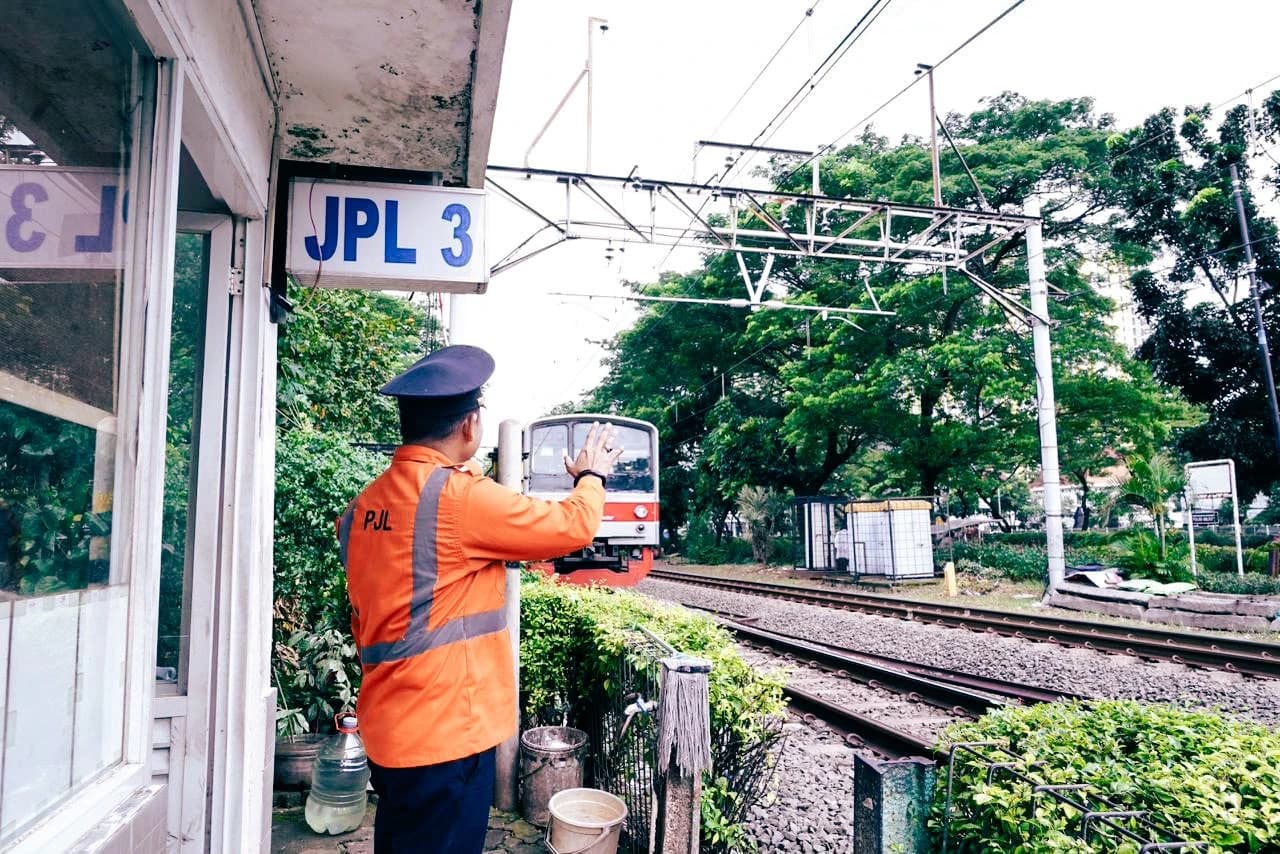
12,957 Applicants Participate in KAI's Railway Crossing Guard Recruitment, Strengthening Safety While Creating Job Opportunities
PT Kereta Api Indonesia (Persero) continues to strengthen safety at level crossings through the deployment of additional Level Crossing Guards (PJL), access improvements, and the closure of crossings identified as having significant safety risks. The program also creates employment opportunities for communities across KAI’s operational regions.
The recruitment process for Level Crossing Guards has received a strong response from the public. A total of 12,957 applicants have joined the selection process for the first phase, which aims to fill 748 PJL positions. The recruitment process is still ongoing, meaning this figure represents the number of positions available in the first phase rather than the number of successful candidates.
Those who successfully complete all recruitment stages will reinforce the existing workforce of 2,126 Level Crossing Guards currently serving in the field.
KAI Vice President Corporate Communication Anne Purba stated that strengthening the PJL workforce is part of the company’s safety strategy while also providing the public with opportunities to contribute directly to public transportation services.
“A total of 12,957 applicants have joined the recruitment process for 748 PJL positions in the first phase. The selection process is still ongoing. For KAI, every officer who is eventually assigned carries an important responsibility because they work directly at the intersection between railway operations and public road activities,” said Anne.
According to Anne, staffing requirements cannot simply be matched to the number of level crossings. A single crossing may require multiple guards because operations are carried out on a shift basis, depending on service hours and the operational characteristics of each location.
“PJL officers work in shifts. When one officer completes a shift, the next officer takes over. Therefore, a single crossing may require several personnel to ensure safety operations continue throughout service hours,” Anne explained.
Based on KAI’s mapping, there are 3,888 level crossings across the company’s operational network. Of these, 2,112 crossings, or approximately 54 percent, are guarded, while 1,776 crossings, or around 46 percent, remain unguarded.
In terms of legal status, 2,799 crossings, or approximately 72 percent, are officially authorized crossings, while 1,089 crossings, or about 28 percent, are categorized as illegal crossings. In addition, KAI has identified 564 grade-separated crossings, including underpasses and flyovers.
Anne said these figures demonstrate that safety improvements require approaches tailored to the conditions of each location. Depending on the circumstances, measures may include stationing guards, upgrading safety facilities, improving access arrangements, or closing crossings based on evaluation results.
The level crossing closure program also continues to move forward. KAI has completed its initial target of closing 172 priority crossings. After reaching this milestone, closure activities have continued at additional locations identified through ongoing evaluations, meaning the total number of closures has now exceeded the original target.
“We have completed the closure of the 172 priority crossings, and improvements are continuing. Whenever evaluations indicate that a crossing poses a safety risk and a safer alternative access route is available, KAI, together with the central government, regional governments, and other stakeholders, will continue improving the location,” Anne said.
The existence of 1,089 illegal crossings also remains a key concern. These crossings are being addressed gradually by considering factors such as risk level, road conditions, surrounding community activities, railway traffic, and the availability of alternative access.
“Every location has different characteristics. Some crossings require stronger guarding, others need access improvements, while some should be closed. Decisions are made based on field evaluations to improve safety while still considering the community’s access needs,” Anne added.
Strengthening personnel and improving level crossings have become increasingly important in light of recent safety data. As of 31 July 2026, KAI recorded 151 accidents at level crossings. This represents an 11 percent decrease compared to 170 incidents during the same period in 2025. The number of vehicles involved fell by 14 percent, from 176 to 152 units, while the number of casualties declined by 26 percent, from 178 to 131 people.
Although these figures show improvement, road user behavior remains the primary challenge. Of the 151 incidents, 132 cases, or 87 percent, were caused by motorists attempting to cross despite warnings, 12 cases, or 8 percent, involved stalled vehicles, and seven cases, or 5 percent, were related to crossing gates closing late or failing to close.
Put simply, nearly nine out of every ten level crossing accidents throughout 2026 were caused by motorists ignoring warnings and attempting to cross.
“KAI continues to strengthen personnel, improve crossings, and close high-risk locations. However, the fact that 87 percent of accidents are caused by road users attempting to cross despite warnings shows that public discipline remains the most critical factor. Whenever warning signals are activated or a train is approaching, road users must stop and give priority to the train,” Anne emphasized.
Of the 151 incidents, 84 cases, or 56 percent, occurred at crossings without gates, while 67 cases, or 44 percent, occurred at gated crossings. A total of 152 vehicles were involved, consisting of 90 motorcycles and 62 cars.
These incidents resulted in 131 casualties, including 59 fatalities, 33 people seriously injured, and 39 people sustaining minor injuries. These figures highlight that the presence of guards, crossing gates, warning signs, and other safety facilities must always be accompanied by compliance from road users.
From a regulatory perspective, Article 124 of Law No. 23 of 2007 on Railways stipulates that at level crossings between railways and roads, road users are required to give priority to trains.
Meanwhile, Article 114 of Law No. 22 of 2009 on Road Traffic and Transportation requires drivers to stop when warning signals are activated, crossing gates begin to close, or other warning signs are present, and to always give priority to trains.
Ahead of the weekend, KAI encourages the public to remain vigilant when approaching railway crossings. Road users are advised to reduce speed before reaching the tracks, obey traffic signs and officers’ instructions, stop whenever warning signals are activated, look both ways, pay attention to their surroundings, and only cross after ensuring it is completely safe.
“Level Crossing Guards perform an essential role in maintaining safety, KAI together with the government continues to improve high-risk crossings, and the public also has an important role through disciplined behavior. Stop for a moment, look both ways, make sure it is safe, then cross. We want every journey to end safely and every person to return home to their family,” Anne concluded.
VP Corporate Communication KAI