
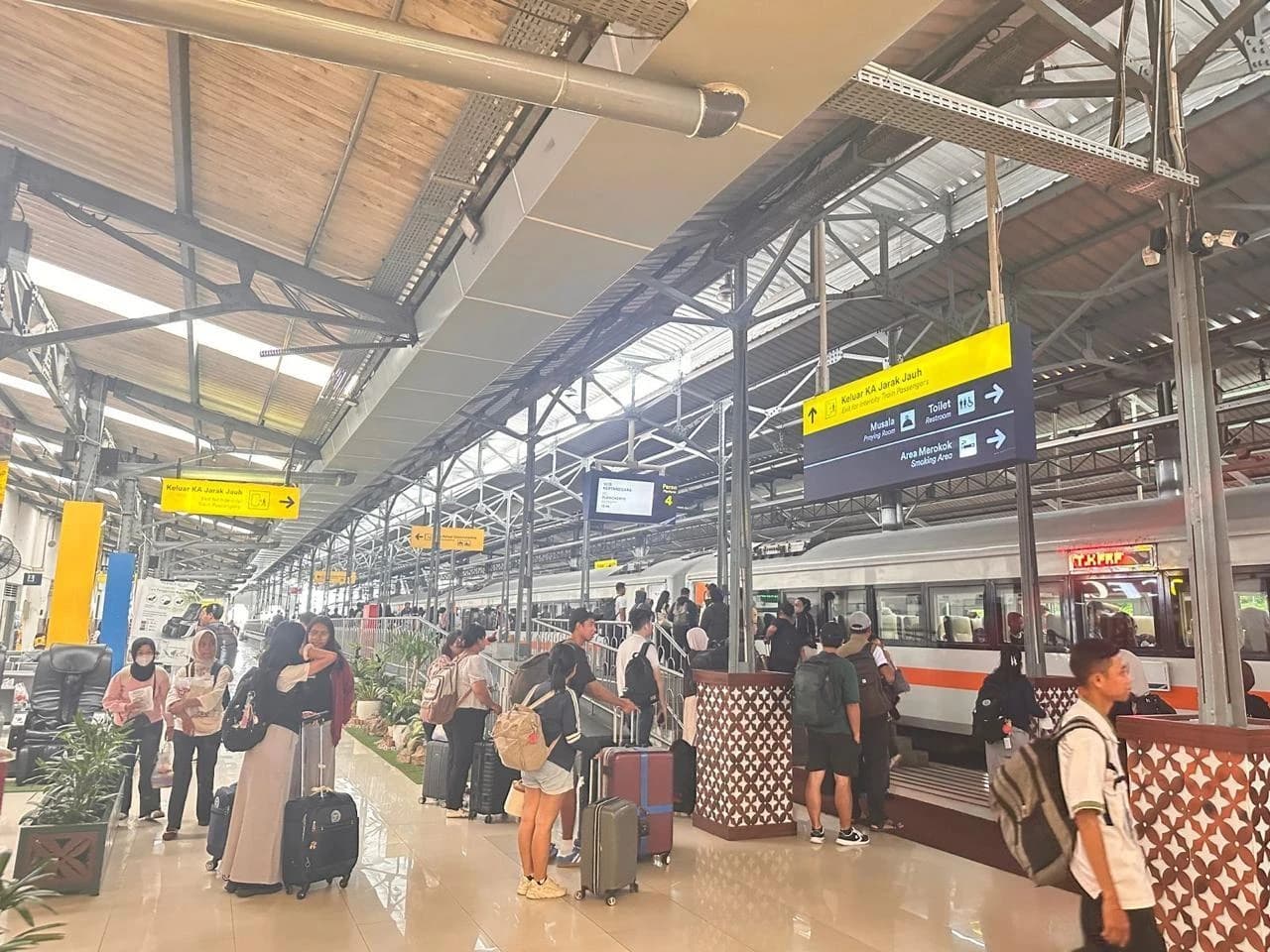
1.24 Million Discounted School Holiday Tickets Booked, KAI Records Cumulative Occupancy of 105.75%
PT Kereta Api Indonesia (Persero) recorded that the 30% Transportation Discount Program during the 2026 school holiday period continues to receive strong public response. As of July 2, 2026, at 10:00 a.m. WIB, the cumulative volume of discounted tickets had reached 1,242,114, or 105.75% of the cumulative capacity of 1,174,624 seats.
The cumulative occupancy exceeding 100% reflects cumulative seat occupancy. This condition is possible because train travel patterns are flexible. Passengers board and disembark at various stations along the route, allowing a single seat to serve different passengers on different travel segments.
The travel period for the 30% Transportation Discount Program runs through July 5, 2026. Customers can regularly check ticket availability through the Access by KAI application. The program is part of the Government's stimulus package aimed at helping the public manage travel expenses during the school holiday period, maintaining purchasing power, and supporting economic activities in regions connected by rail services.
The policy was previously announced by Coordinating Minister for Economic Affairs Airlangga Hartarto as part of the Government's stimulus measures to maintain public purchasing power and support economic activity. In his official statement, Airlangga said, "For railway transportation, a 30 percent fare discount is provided for travel during the period of June 20–July 5, 2026."
In implementing the program within the railway sector, KAI collaborates with the Directorate General of Railways (DJKA) of the Ministry of Transportation to provide discounted fares to customers during the designated period.
KAI Vice President of Corporate Communication Anne Purba stated that the high volume of discounted ticket bookings demonstrates that the transportation stimulus provides direct benefits to the public. The program helps families plan vacations, enables school and university students to travel, and allows people to reach educational destinations, tourist attractions, agglomeration areas, and economic centers at more affordable costs.
"The 30% Transportation Discount Program gives people greater flexibility to plan their school holiday trips more economically. Cumulative occupancy exceeding 100% shows that train seats are being utilized optimally throughout the route. Many passengers board and alight at different stations, enabling the service to accommodate more people within the same travel period," Anne said.
Anne explained that the highest volume of discounted ticket bookings occurred on June 28, 2026, with 90,366 passengers. This was followed by June 27 with 87,175 passengers, June 26 with 85,397 passengers, June 21 with 82,061 passengers, and June 29 with 81,890 passengers.
Based on passenger volume data as of July 2, 2026, at 9:00 a.m. WIB, total passengers for departures between June 20 and July 5, 2026, reached 3,164,814. This figure consisted of 1,240,358 discounted-ticket passengers and 1,924,456 non-discount passengers. Discounted-ticket passengers accounted for 39.2% of the total passengers during the period.
Compared with the 2025 school holiday period, the 2026 discounted-ticket passenger volume has reached 106% of the previous year's figure. Meanwhile, total passenger volume across all categories reached 95% of the 2025 period, which recorded 3,326,281 passengers.
From June 20 to July 2, 2026, discounted passenger volume consistently remained above the corresponding dates in 2025. The highest increase occurred on June 28, 2026, when discounted passenger volume reached 124% compared with the 2025 school holiday period.
"This data shows that transportation stimulus has become an important part of people's travel planning. Customers can choose their departure dates, adjust their destinations, and use rail transportation for more well-planned journeys," Anne said.
KAI recorded the five busiest departure stations during the period: Pasar Senen Station with 134,988 passengers, Yogyakarta Station with 84,951 passengers, Semarang Poncol Station with 63,182 passengers, Semarang Tawang Bank Jateng Station with 61,189 passengers, and Surabaya Pasarturi Station with 49,507 passengers.
For destination stations, the highest passenger volumes were recorded at Pasar Senen Station with 126,728 passengers, Yogyakarta Station with 86,269 passengers, Semarang Poncol Station with 61,730 passengers, Semarang Tawang Bank Jateng Station with 60,776 passengers, and Surabaya Pasarturi Station with 52,348 passengers.
The routes with the highest passenger volumes highlight the strong travel demand between Jakarta, Yogyakarta, Semarang, Solo, and Surabaya. The top five routes were Lempuyangan–Pasar Senen with 17,718 passengers, Pasar Senen–Lempuyangan with 16,918 passengers, Surabaya Gubeng–Yogyakarta with 15,100 passengers, Pasar Senen–Yogyakarta with 14,935 passengers, and Solo Balapan–Semarang Tawang Bank Jateng with 14,891 passengers.
According to Anne, this pattern shows that school holidays generate diverse travel characteristics. Some passengers travel long distances between cities, while others use agglomeration and medium-distance intercity services for short vacations, family visits, educational purposes, and trips to tourist destinations.
From the service perspective, the five trains with the highest passenger volumes during the period were Joglosemarkerto with 64,284 passengers, Ambarawa Ekspres with 63,732 passengers, Pangrango with 48,539 passengers, Kaligung with 47,010 passengers, and Kamandaka with 45,031 passengers.
The inclusion of Joglosemarkerto, Ambarawa Ekspres, Pangrango, Kaligung, and Kamandaka among the highest-volume services demonstrates that the benefits of the stimulus extend to daily and medium-distance travel across many regions. These services connect cities that serve as centers for education, family tourism, commerce, employment, and family visits.
"Every customer journey is also connected to activities in the surrounding areas. Some families are on vacation, students are traveling, customers are visiting relatives, and others are heading to cities with economic and tourism activities. At these locations, stations become hubs where mobility and local economic activity intersect," Anne said.
In terms of travel direction based on train numbers, passenger volume on odd-numbered trains was higher than on even-numbered trains. During the period from June 20 to July 5, 2026, odd-numbered trains recorded 669,451 passengers, or approximately 53.9%, while even-numbered trains carried 572,663 passengers, or approximately 46.1%. The highest passenger volume for odd-numbered trains occurred on June 28, 2026, with 48,014 passengers, while the highest volume for even-numbered trains also occurred on the same date, with 42,352 passengers.
KAI encourages customers who have purchased tickets to reconfirm their departure schedules, identity information, and travel requirements through the Access by KAI application, the official website kai.id, and other official channels. Customers are also advised to arrive at the station early to ensure a smooth boarding process.
"KAI thanks the public for continuing to choose rail transportation during the school holiday period. Through the Government's stimulus support and collaboration with the Directorate General of Railways of the Ministry of Transportation, KAI will continue to provide services that are safe, comfortable, orderly, and easily accessible for our customers," Anne concluded.
VP Corporate Communication KAI