
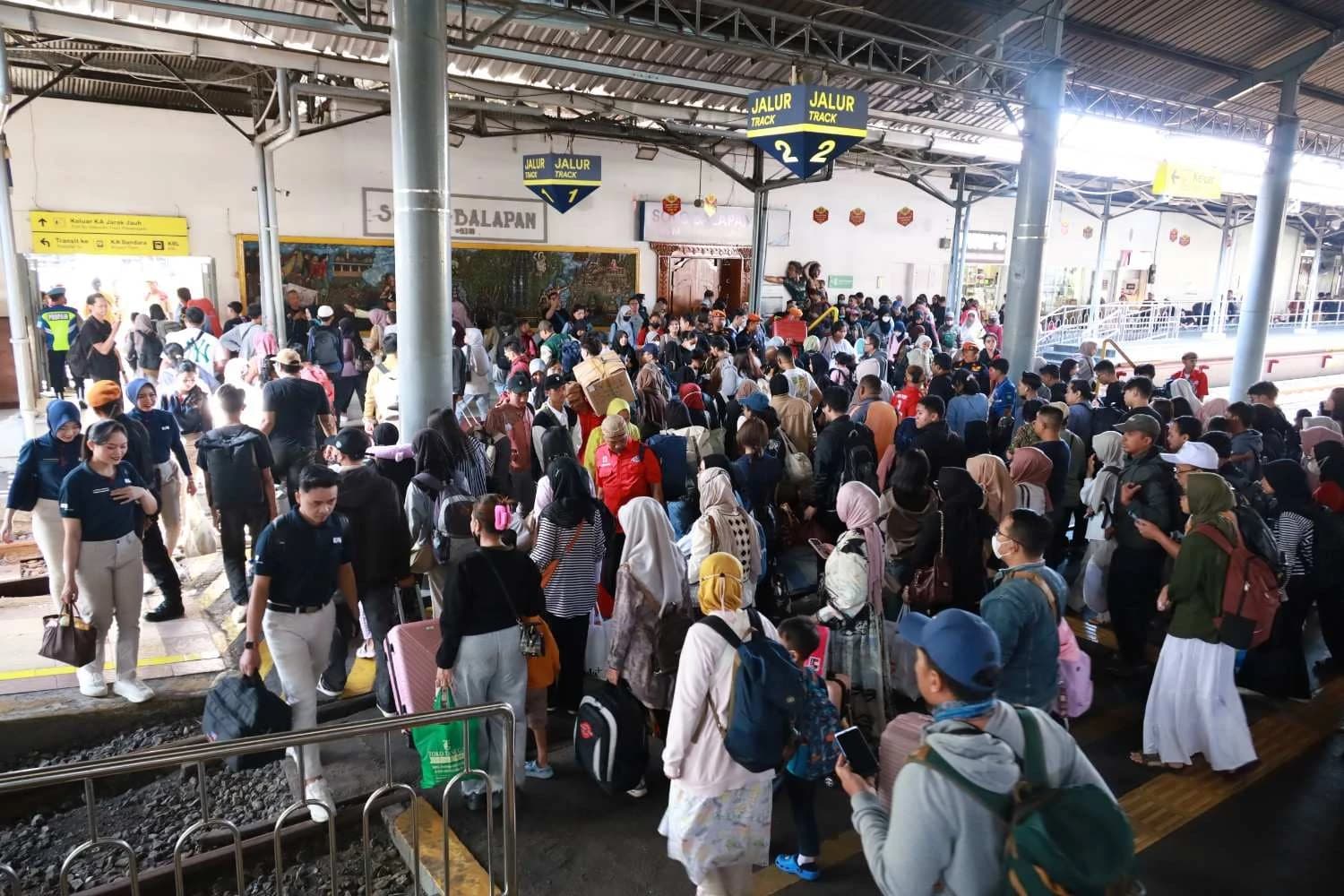
1,10 Million Customers Use Joglosemarkerto Train Through September 2026, Up 9,73 Percent
Intercity mobility in Central Java and the Special Region of Yogyakarta continued to grow throughout 2026. PT Kereta Api Indonesia (Persero) recorded that the Joglosemarkerto Train served 1,104,419 customers during January–September 2026, an increase of 9.73 percent compared with 1,006,467 customers in the same period in 2025.
In absolute terms, the number of customers increased by 97,952 over the nine-month period. This growth demonstrates the strong demand for intercity travel along the Central Java–Yogyakarta corridor, which connects various centers of economic, educational, governmental, and tourism activities.
Vice President Corporate Communication KAI Anne Purba said Joglosemarkerto has a distinctive service characteristic as it connects multiple cities through a circular travel pattern. The cities connected include Semarang, Solo, Yogyakarta, Purwokerto, Tegal, Pekalongan, as well as several areas along the route.
“More than 1.1 million customers used Joglosemarkerto from January to September 2026. Compared with the same period last year, the number increased by nearly 98 thousand customers. This data shows the high demand for intercity travel in Central Java and the Special Region of Yogyakarta throughout the year,” said Anne.
The strong mobility in the area is also reflected in tourism activity. Statistics Indonesia (BPS) of Central Java Province recorded that domestic tourist trips to Central Java in August 2026 reached 13.79 million trips, an increase of 25.80 percent compared with August 2025. At the national level, the number of domestic tourist trips in August 2026 reached 104.30 million trips, an annual increase of 11.47 percent.
According to Anne, the high volume of travel is in line with the characteristics of the areas served by Joglosemarkerto. Semarang, Solo, Yogyakarta, Purwokerto, Tegal, Pekalongan, and the cities in between have diverse travel connections, ranging from work, education, and trade to family visits and tourism.
“Customer travel patterns along this corridor are highly diverse. Someone may travel from Solo to Semarang for work, from Yogyakarta to Purwokerto for education or a family visit, or travel between cities for tourism and economic activities. Such patterns form a strong regional travel market,” said Anne.
Joglosemarkerto is also one of the commercial services with a high customer volume. In the first half of 2026, all Joglosemarkerto journeys served approximately 730 thousand customers, an increase of 10.29 percent compared with the first half of 2025. Joglosemarkerto Train 187 and Train 193 even ranked first and second among commercial trains based on the number of customers during the period.
The circular travel pattern allows customers to use Joglosemarkerto across multiple city pairs within a single travel network. This characteristic enables the service to reach a distributed travel market without relying on a single city as the primary destination.
“The 9.73 percent growth through September provides an indication that regional mobility continues to develop. KAI will assess demand patterns across each travel segment as a basis for managing the capacity and service of Joglosemarkerto going forward,” concluded Anne.
VP Corporate Communication KAI