
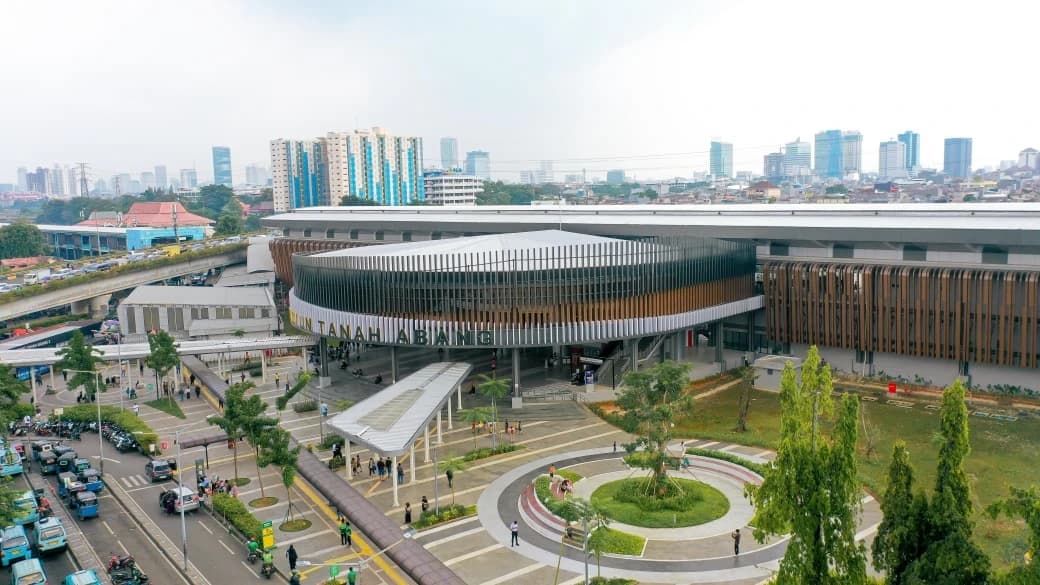
11 Million Commuters, KAI Strengthens the Role of Train in Daily Interregional Mobility
The mobility patterns of Indonesian people are increasingly crossing regional boundaries. The 2025 Inter-Census Population Survey (SUPAS) conducted by the Central Statistics Agency (BPS) recorded approximately 11 million Indonesians as commuters. This figure illustrates the growing need for routine travel as people become increasingly connected between residential areas and centers of employment, education, and various activity hubs.
These changes in mobility patterns are also reflected in the use of rail-based transportation. From January 1–July 31, 2026, KAI Group through KAI Commuter served 242,932,764 customers, an increase of 6.65% compared to 227,781,787 customers during the same period in 2025. During these 212 days, KAI Commuter services averaged approximately 1.15 million customers per day.
Commuter Line Jabodetabek was the largest contributor with 210,468,029 customers, growing 6.39% compared to 197,833,176 customers in January–July 2025. This volume accounted for approximately 86.64% of KAI Commuter’s total customers during the first seven months of 2026, demonstrating the significant need for mass transportation to support community activities in Indonesia’s largest metropolitan area.
Growth was also recorded outside Jabodetabek. KAI Commuter services in the Bandung area reached 11,872,273 customers, an increase of 8.55% compared to 10,936,955 customers. In the Surabaya area, the volume reached 10,009,552 customers, growing 8.15% from 9,255,362 customers. Meanwhile, Commuter Line Yogyakarta served 5,630,179 customers, an increase of 7.39% compared to 5,242,906 customers during the same period last year.
A similar trend was seen on Commuter Line Basoetta, which recorded 1,392,113 customers, an increase of 9.85% from 1,267,286 customers. Prameks services grew 6.69%, from 649,266 to 692,699 customers. Meanwhile, KAI Commuter services in the Merak area recorded 2,867,919 customers, an increase of 10.44% compared to 2,596,836 customers in January–July 2025.
Vice President Corporate Communication KAI Anne Purba said the development demonstrates the increasingly important role of mass transportation in supporting community activities that cross regional boundaries.
“People’s mobility is increasingly crossing regional boundaries. For KAI, this trend underscores the importance of Train as the backbone of mass transportation in urban and agglomeration areas,” said Anne.
Growth across various regions also shows that the need for rail-based travel is developing with different characteristics. Jabodetabek has the largest travel scale, while Bandung, Yogyakarta, Surabaya, Merak, and Basoetta recorded higher growth than Jabodetabek during the January–July 2026 period.
“Growth across various regions serves as a basis for KAI to continuously adjust capacity, service patterns, and connectivity to developments in community mobility needs,” said Anne.
KAI views changes in commuter patterns as part of the dynamics of Indonesia’s urban development. The increasing connectivity between residential areas and centers of employment, education, and economic activity makes rail-based transportation increasingly strategic for serving high-capacity and scheduled journeys. Through the KAI Group ecosystem, developments in customer volumes and travel patterns will continue to serve as one of the foundations for developing services and interregional connectivity.
VP Corporate Communication KAI