
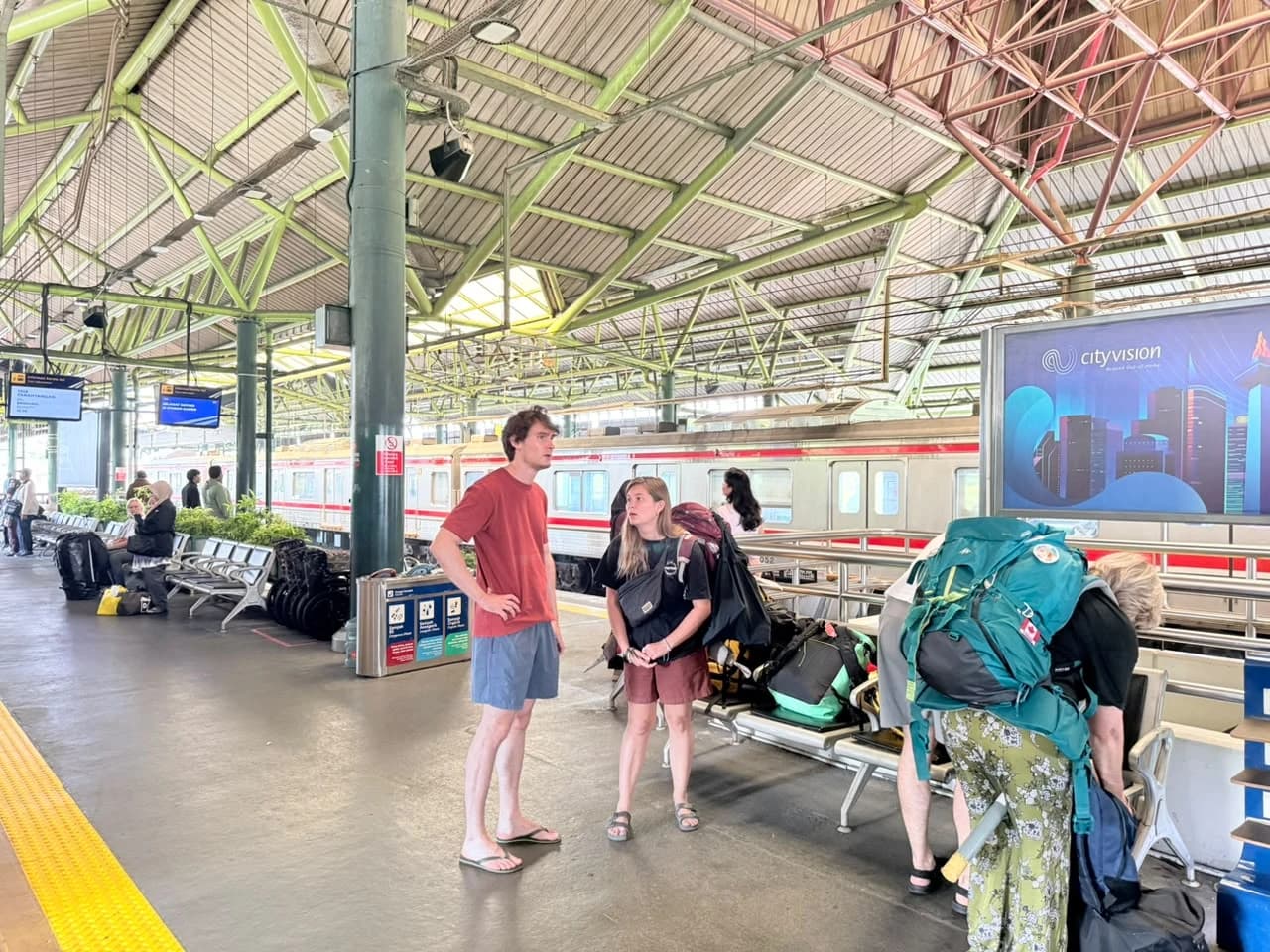
106,474 International Tourists Departed from 222 Stations Beyond Indonesia’s Top 10 Busiest Stations, Reflecting the Expanding Reach of Rail Travel
International tourists’ train travel during the first semester of 2026 showed an increasingly widespread pattern across cities in Java and Sumatra. Data from PT Kereta Api Indonesia (Persero) recorded 308,874 international tourists using long-distance trains from January to June 2026, up 2.54% compared with 301,219 passengers during the same period last year.
Of that total, 106,474 passengers, or 34.47%, departed from 222 stations outside the 10 stations with the highest international tourist volume. The figure indicates that roughly one in three international tourists using long-distance trains began their journey from a regional station.
This distribution grew faster than the overall growth in KAI’s international tourist volume. In the first semester of 2025, stations outside the top 10 served 101,531 passengers. The number increased by 4,943 passengers, or 4.87%, in the first semester of 2026.
The increase from regional stations accounted for 64.57% of the net increase of 7,655 international passengers over the past year. Meanwhile, the share of journeys originating outside the 10 busiest stations rose from 33.71% to 34.47%.
The data show that the increase in international tourist train travel was driven more by expanding activity across a broader network of stations, even though the main stations continued to serve the majority of passengers.
KAI Vice President of Corporate Communication Anne Purba said the wider distribution of journeys could serve as an indicator of the growing range of destinations chosen by international tourists in Indonesia.
“Tourists are beginning to use more stations as starting points for their journeys. This pattern creates opportunities for regional cities to showcase their cultural heritage, culinary attractions, history, natural assets, and local community life,” said Anne.
The development occurred as international arrivals to Indonesia also continued to increase. Statistics Indonesia (BPS) reported that international tourist visits in May 2026 reached 1.38 million, up 5.83% compared with May 2025. Globally, UN Tourism recorded a 2% increase in international travel during the first quarter of 2026 and projected annual growth of around 3–4% for the full year.
Within KAI’s network, the growth in international tourist travel was not uniform. Eleven of the company’s 13 operating regions recorded increases compared with the first semester of 2025, while two regions experienced declines.
The highest percentage increase was recorded by Regional Division IV Tanjungkarang at 12.76%. This was followed by Operation Area 4 Semarang at 12.38%, Operation Area 5 Purwokerto at 11.46%, and Operation Area 8 Surabaya at 11.42%.
The interregional pattern indicates that demand from international tourists is not concentrated in a single area. Cities in Central Java, East Java, and Lampung are beginning to capture a larger share of international passenger flows.
At the station level, Purwokerto served 5,780 international tourists in the first semester of 2026, up 20.54% from 4,795 passengers during the same period last year. Tegal recorded 2,980 passengers, an increase of 23.55%, while Kiaracondong served 2,018 passengers, up 18.08%.
Even higher growth rates were seen at stations with smaller passenger bases. Garut served 587 international tourists, up 41.79%. Purwakarta recorded 617 passengers, an increase of 56.20%. Bogor Paledang served 1,262 passengers, approximately three times higher than the 420 passengers recorded in the first semester of 2025.
These growth rates should be viewed alongside the underlying passenger volumes. Major stations remain the dominant gateways, while growth at regional stations provides an early signal of increasingly diverse travel choices.
“Station-level data can help regional governments identify changes in visitation patterns. The information can be used to prepare connecting transportation, destination information, public facilities, and services that match the needs of tourists,” Anne said.
The broader distribution of journeys has the potential to expand tourism benefits when stations are well connected to destination areas. Tourists arriving by train require onward transportation, accommodation, food services, guides, information services, handicraft products, and a variety of cultural and nature-based tourism activities.
These needs can create opportunities for micro, small, and medium enterprises, accommodation operators, travel service providers, cultural communities, and other creative economy actors. The scale of benefits received by local communities will depend on the ease of access from stations, the quality of information, security, cleanliness, and the readiness of services at the destination.
“Stations can serve as gateways to local experiences. Strong connectivity helps tourists reach destinations while also connecting them with local products and community-based services,” Anne added.
KAI currently manages a network of 627 stations and 7,765 kilometers of active railway lines across Java and Sumatra. The network supports intercity travel and connects major activity centers with regions that offer diverse tourism characteristics.
According to Anne, safety, punctuality, cleanliness, onboard comfort, ease of booking, accessible information, and seamless connections to onward transportation are essential components of the travel experience for international passengers.
“The expansion of journeys to 222 regional stations shows that the benefits of connectivity can reach more regions. This potential needs to be matched with destination readiness and collaboration among stakeholders so that tourist travel can generate broader value for local communities,” Anne concluded.
VP Corporate Communication KAI