
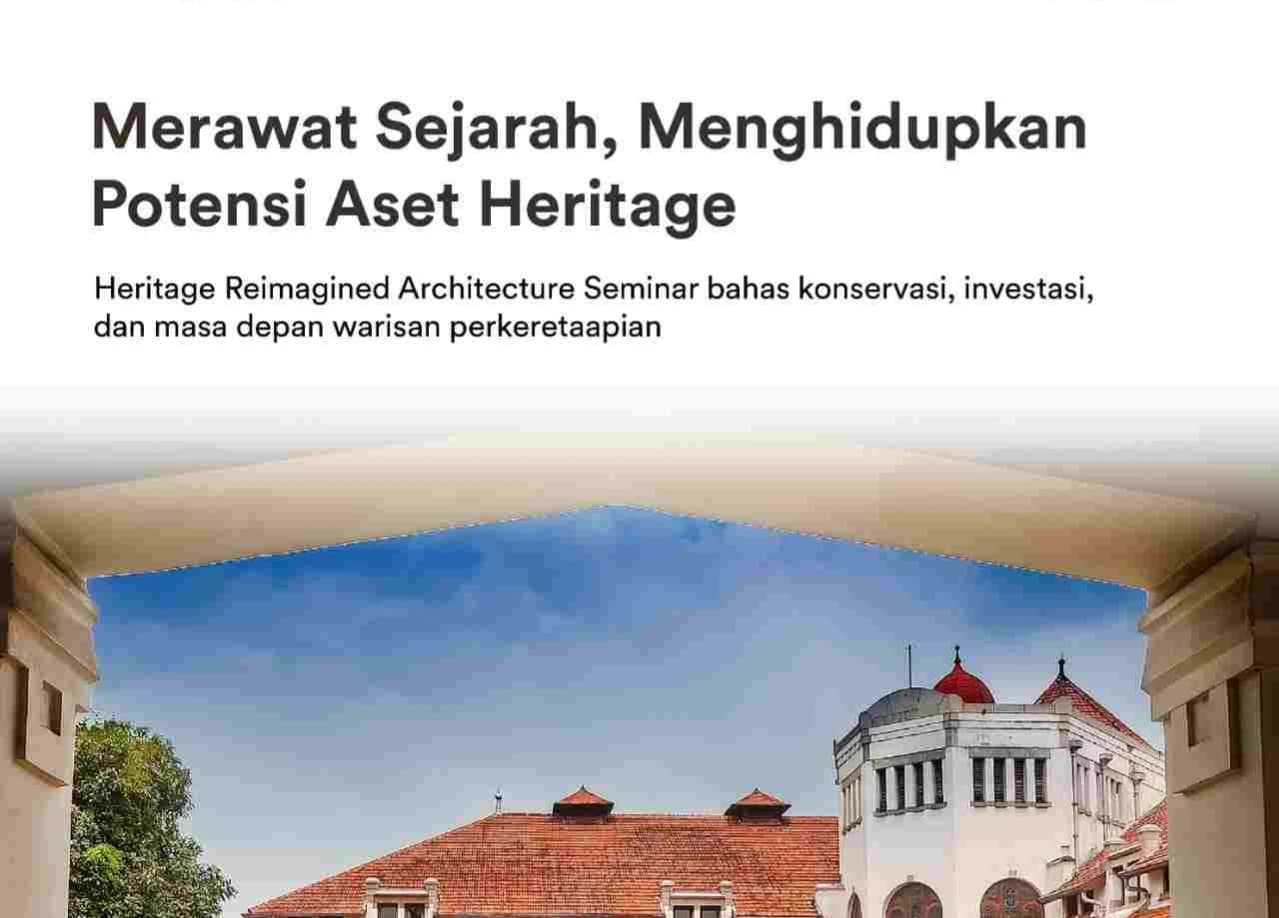
KAI Heritage Week 2026 : Heritage Reimaged Architecture Seminar
KAI held the Heritage Reimagined: Architecture Seminar on Thursday, November 12, 2026, at the Lawang Sewu Museum in Semarang. The seminar was part of KAI Heritage Week 2026, held from November 9 to 15, 2026, to celebrate 159 years of railway history in Indonesia.
The event brought together academics, conservation experts, property industry professionals, and government representatives to share perspectives on preserving historic buildings and exploring the potential of heritage assets to meet the changing needs of society.
Four Perspectives on the Future of Heritage Assets
Through the Heritage Reimagined: Architecture Seminar, KAI brought together experts to discuss four key approaches:
Architectural Conservation
Preserving the original character of historic buildings while adapting their functions to modern needs.
Heritage Investment
Exploring the economic potential and business feasibility of heritage assets.
Creative Financing
Developing alternative funding solutions and investment partnerships.
Regulations and Policies
Balancing cultural heritage protection with urban development.
Historic Assets as Drivers of Urban Economic Growth
Preserving historic buildings requires a balance between protecting their historical value and meeting modern service needs.
Prof. Ir. Ikaputra, M.Eng., Ph.D., Professor of Architecture at Universitas Gadjah Mada (UGM), emphasized the importance of a multidisciplinary approach to heritage asset management.
According to him, architecture, conservation, economic considerations, and regulations must be considered together when planning the development of historic buildings.
He also emphasized that planning for the future use of cultural heritage assets is essential, describing it as "a must."

Preserving Architectural Authenticity While Meeting Modern Needs
The discussion continued with Ar. Ir. Arya Abieta, M.Ars., a cultural heritage conservation expert, who shared examples of how Pasar Senen Station and Semarang Tawang Station could be adapted to meet modern needs.
At Pasar Senen Station, plans to improve accessibility by potentially installing escalators in the historic underpass must take into account the protection of the building's original architectural features. Meanwhile, conservation efforts at Semarang Tawang Station also involve restoring historical elevation levels and managing flood risks. These examples show that modern facility improvements require careful planning to enhance the functionality of historic buildings while preserving their historical value.
"Successful adaptation of heritage buildings can be achieved when their historical value remains protected, modern service needs are met, and maintenance costs can be planned sustainably," said Arya.

Unlocking the Economic Potential of Heritage Assets
Historic buildings have economic value because of their unique architecture, strategic locations, and cultural and tourism appeal. Linda Wijaya, CEO of the Indonesia Real Estate Institute (IREI), discussed opportunities to develop heritage assets through adaptive reuse, which involves giving historic buildings new functions while preserving their original character.
Through this approach, heritage buildings can be transformed into commercial spaces, galleries, public facilities, and venues for creative activities. Proper management can create economic opportunities while supporting the long-term preservation of historic buildings.
"Preservation requires investment, and investment requires incentives," said Linda.

Innovative Financing for Sustainable Heritage Preservation
Beyond conservation and building reuse, the long-term sustainability of heritage assets also requires financial support and investment partnerships. Milda Zainal Abidin and Rahmi Fauziah from Jones Lang LaSalle (JLL) discussed various financing approaches, including property leasing, commercial space management, and long-term investment partnerships.
One example discussed was the potential development of Building A at Lawang Sewu into spaces for culinary activities, galleries, exhibitions, and creative events through well-structured partnership arrangements.
This approach creates opportunities to maintain historic buildings, support their sustainable use, and provide benefits to local communities.
"Heritage asset management requires innovative financing and strategic partnerships to ensure that long-term use and preservation can go hand in hand," said Milda.
Collaboration to Preserve Railway Heritage
Preserving heritage assets also requires regulatory support and cooperation among various stakeholders. Dr. Indriyasari, S.E., M.A.P., Head of the Semarang City Culture and Tourism Office, explained the importance of the government's role as a regulator, facilitator, catalyst, and supervisor in managing historic assets.
Developing heritage tourism requires collaboration among the government, state-owned enterprises, the private sector, academics, and local communities. Such cooperation helps protect historical value while supporting regional economic development.
"Regulations are not barriers that restrict heritage assets, but roadmaps that provide greater certainty for heritage investment," said Indriyasari.
Through the Heritage Reimagined: Architecture Seminar, KAI encouraged knowledge sharing and collaboration to support the sustainable management of historic assets. The seminar aimed to offer new perspectives on how heritage buildings can provide cultural, educational, and economic value while preserving their authenticity and historical character.
For more information about KAI Heritage Week 2026 and its activities, visit KAI's official Instagram account at @kaiuntukidn.